Warehouse automation has today become not just a trend, but a necessity for any business dealing with goods, logistics, and inventory. The larger the volume of operations, the more difficult it is to control them manually. Accounting errors, delays, overspending, and product losses directly impact profits.
What solutions exist for automating warehouse processes and how to choose the optimal warehouse management software for your business, we will explore further.
What is warehouse automation and why is it needed?
Warehouse automation is the implementation of software and technical solutions that minimize manual labor and allow for full control over all warehouse operations. Its main goal is to make the warehouse transparent and manageable. It covers the following processes:
- Accounting of goods. The implemented warehouse accounting program records every movement of the nomenclature: from acceptance to shipment, including serial numbers, expiration dates, and batch accounting.
- Real-time balance control. The system displays current balances without the need for manual stocktaking, which eliminates «paper» discrepancies.
- Moving between warehouses. Very important for those businesses that have several warehouses. It will automatically record internal movements between zones, cells, or branches without duplicating documents.
- Inventory. Instead of the annual «counting of everything», the WMS system allows you to conduct a cyclic inventory without stopping the warehouse.
- Order processing. Automatic generation of picking tasks, prioritization by shipment time, optimization of the picker's route through the warehouse.
What is included in warehouse automation
Warehouse automation is a complex process that includes not only the program but also the restructuring of business processes:
- Software implementation: selection and customization of a WMS, ERP, or specialized accounting system to meet specific business needs.
- Setting up warehouse logic: defining zones (receiving, storage, shipping, return), rules for placing goods, address storage, FIFO/FEFO rules.
- Integration with CRM and ERP: synchronization of inventory accounting with sales, procurement, and finance in a unified information space.
- Connecting scanners and DTCs: Data collection terminals (DTCs) and barcode scanners allow warehouse workers to perform tasks without paperwork, which reduces transaction time and errors.
- Staff training: effective automation is impossible without team preparation: employees must understand the new logic of work, not bypass the system «in the old way.».
Properly implemented automation of warehouse processes can reduce costs and increase the speed of work by several times. According to market implementations, the accuracy of accounting after automation increases to 99.5%, the number of required personnel decreases by 30%, and the warehouse capacity increases by 10-15%.
Using a warehouse management system is the foundation of automation.
The key element is the warehouse management system. It is a software solution that allows for centralized management of all processes. A modern warehouse management system (WMS system) provides:
- Addressed storage of goods, thanks to which you can find any item in a matter of seconds, which significantly reduces the time for order picking.
- Optimization of order picking routes. The WMS system automatically builds the shortest route through the warehouse for the picker.
- Personnel control, specifically: who performed which operation and when.
- Reducing shipping errors. Thanks to verification via barcode scanning or RFID tags, the system prevents incorrect items or quantities from being shipped.
- Detailed analytics and reporting. You have detailed reports on warehouse operations, process efficiency, inventory, and other key metrics, transforming what used to be stored in paper reports into structured electronic data
Inventory management system: control and planning
Equally important in a warehouse is the use of an inventory management system that is responsible for the correct balance of goods. Its main functions:
- analysis of residuals;
- demand forecasting;
- automatic procurement formation;
- prevention of shortages or surpluses.
Among the main inventory management systems, one can highlight:
- ERP solutions;
- WMS systems;
- specialized programs for warehouse goods accounting (where a full ERP is not required, but convenient accounting and basic analytics are important).
It is the combination of a warehouse management system and an inventory management system that gives the maximum effect: the former is responsible for the physical movement of goods within the warehouse, and the latter is responsible for the strategic balance of inventory.
How to choose inventory management software: essential features
Choosing an inventory management program is one of the most important steps. An inventory management program will be effective only if it is:
- Support multi-layered accounting;
- flexible settings;
- provide analytics;
- easy to integrate with other systems.
A popular solution is also inventory management software, which is suitable for small and medium-sized businesses. Modern warehouse management software can operate both in the cloud (SaaS model with monthly payments) and locally (one-time license purchase with deployment on your own server).
Warehouse automation cost
A request for warehouse automation costs is one of the most common. The pricing depends on:
- warehouse size and process complexity
- number of users
- type of system (WMS, ERP, customized solution)
- availability of integrations (connecting to third-party systems such as an online store, CRM, marketplaces will increase the budget, but it pays off by eliminating manual data entry).
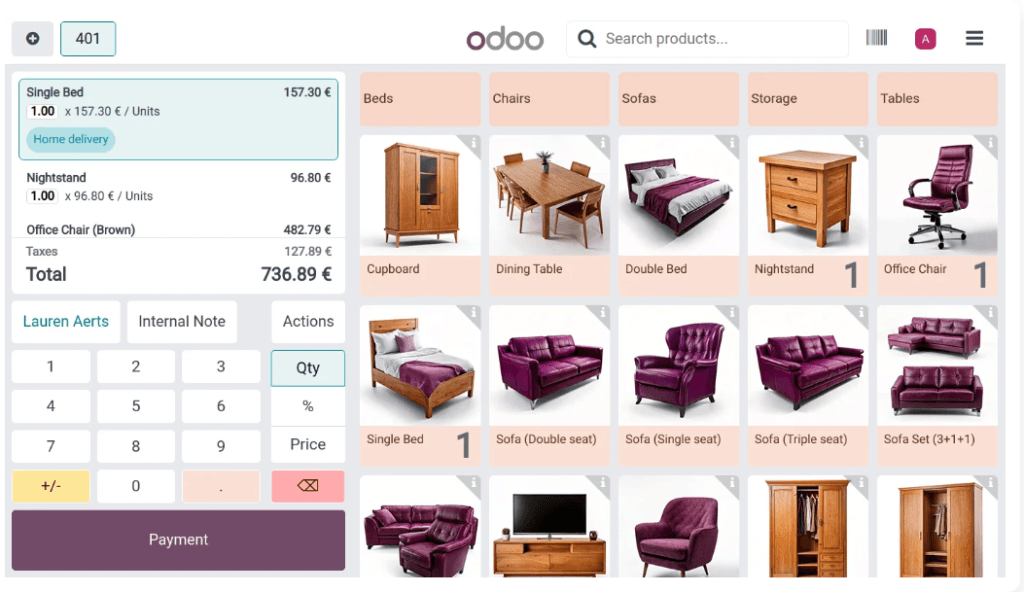
On average, warehouse automation pays for itself through process optimization and reduced losses. You can always turn to ToDo company for the implementation of this task based on the ERP Odoo. More about warehouse automation based on the Odoo system can be read on the “Warehouse automation”.
We work comprehensively and offer:
- Analysis of current processes.
- Choosing a solution.
- Setting up the system.
- Testing.
- Team training.
- Launch and support.
This approach ensures efficient warehouse automation. Therefore, if you are planning to scale or are already facing accounting issues, it is time to implement warehouse process automation.